
Viral Jack Neel and Jiang Xueqin Podcast Clip Revives Bitcoin Deep State Theory
A viral clip from the Jack Neel Podcast sent a Beijing-based commentator’s CIA-created- Bitcoin theory ricocheting across X, Tiktok, and crypto forums on Wednesday.
Key Takeaways:
- A viral clip from Jack Neel Podcast Episode 86 shows Jiang Xueqin claiming the CIA created Bitcoin in 2026.
- Jiang’s theory, built on game theory framing, has reached 2.3M YouTube subscribers with zero documentary evidence.
- Crypto analysts and rebuttals on Youtube say Bitcoin’s open-source code directly contradicts Jiang’s surveillance thesis.
Predictive History’s Jiang Xueqin Says Bitcoin Is a Deep State Surveillance Tool
The clip, pulled from Episode 86, Part 2 of the Jack Neel Podcast and amplified by several crypto accounts, features Jiang Xueqin, a Chinese-Canadian high school history teacher who runs the Youtube channel Predictive History. The roughly four-minute excerpt centers on Jiang’s claim that Bitcoin was built by the American deep state as a surveillance and black-operations funding tool.
Jiang, who carries the informal online title “Professor” despite holding no university post, frames his case using what he calls game theory. Bitcoin.com News has featured Jiang on several occasions, as some of his predictions, like Trump winning the election and the U.S. going to war with Iran, have come true.
His Bitcoin argument, explained in an interview setting with Neel, follows three questions: who had the technical capacity to build Bitcoin, who benefits from its transparent ledger, and why would anyone build such a system and give it away for free. His answers point to DARPA, the NSA, and the CIA each time.
“When you do game theory analysis, you look at all possibilities, you end up with the deep state,” Jiang says in the clip. “You end up with the CIA.”
His supporting logic includes DARPA’s documented role in building ARPANET, the network that preceded the public internet, as proof that military agencies routinely launch technologies later framed as civilian innovations. He also argues that Bitcoin’s public blockchain ledger, far from a privacy tool, functions as a permanent record that intelligence agencies can mine without restriction.

Jiang goes further, claiming that the Winklevoss twins’ early bitcoin investment, made after their Facebook settlement, suggests insider knowledge of the asset’s true origins. “How did they know?” he asks on camera. “They had insider information.” Jack Neel, the podcast host, reacts throughout with laughter and brief affirmations. He does not challenge the claims in the shared clip.
Jiang’s following grew massively after he publicly forecast Donald Trump‘s 2024 presidential victory and a subsequent U.S.-Iran military escalation, both of which he described in classroom-style Youtube lectures. His Predictive History channel reached 2.3 million subscribers by April 2026, and clips of his geopolitical lectures spread across every major platform. He’s being interviewed by everyone under the sun these days as he’s very charismatic.
Jiang’s Bitcoin theory has also surfaced in older lectures that resurfaced alongside that coverage. The problem is that Jiang offers no documents, leaks, or whistleblowers. His argument rests on pattern recognition applied selectively: DARPA built the internet, therefore DARPA could have built Bitcoin; the blockchain is transparent, therefore it serves surveillance; Satoshi Nakamoto remained anonymous, therefore the creator must have had institutional cover.
On social media many observers pointed out the obvious gaps in Jiang’s theory. Bitcoin’s design, laid out in the 2008 white paper, is explicitly built around removing trusted third parties from financial transactions. A state surveillance project would require the opposite architecture. The codebase is fully open-source and has been maintained by a global volunteer community for 17 years, a development history inconsistent with a single agency running a covert honeypot.
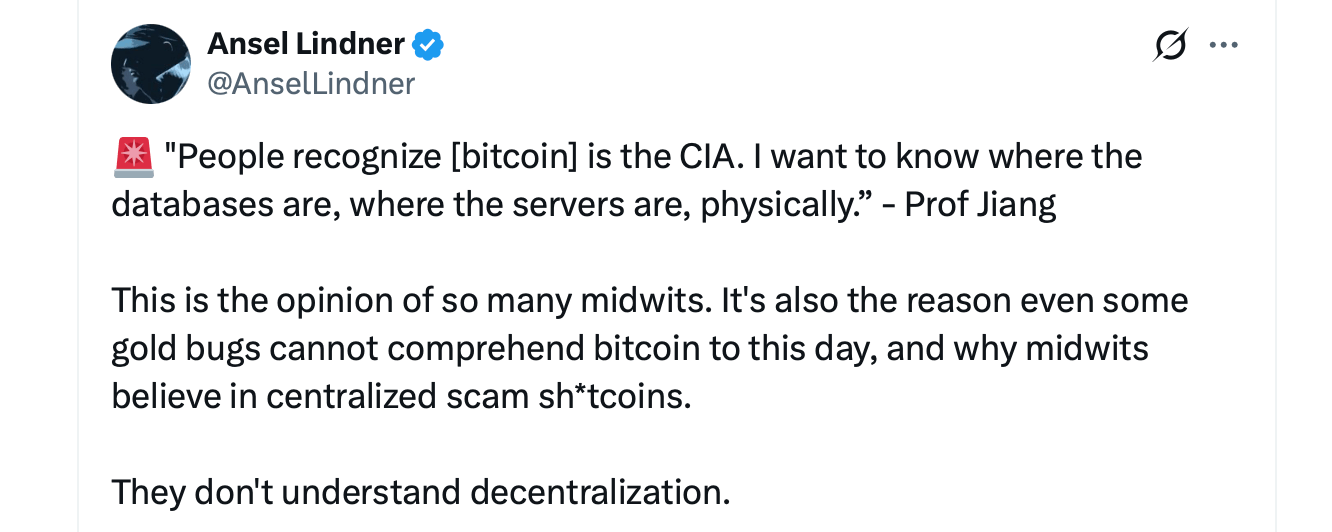
The cypherpunk intellectual lineage behind Bitcoin, including Hal Finney and Wei Dai is publicly documented and predates any known U.S. intelligence interest in decentralized digital cash. Multiple Youtube rebuttals, including a widely-shared video titled “Prof Jiang doesn’t understand Bitcoin,” detail what critics describe as technical errors in his characterization of mining economics, decentralization, and onchain privacy.
Jiang’s broader geopolitical thesis holds that U.S. imperial decline will push capital toward hard assets like bitcoin. The Bitcoin-as-CIA-project claim sits awkwardly against that prediction, framing the asset as both a symptom of American overreach and the inevitable beneficiary of its collapse.
The theory is not new. Versions of it have circulated in crypto forums for years, often citing the NSA’s 1990s work in cryptographic research. Jiang’s reach has given it a wider platform once again. That is the most notable thing that changed this week.
Related Articles

Bitcoin Exchange Binance Announces It Will List This Altcoin on Its Futures Trading Platform! Here Are the Details
Binance Futures, one of the world’s largest crypto derivatives platforms, has announced a new step to expand its trading options. According to the announcement,...

Bitcoin Price Passes $75,000 as Iran War Turns It From ‘Digital Gold’ Into Geopolitical Settlement Bet
Bitcoin price jumped past $75,000 on Wednesday as traders recalibrated what the asset represents in the wake of the Iran conflict and an unusually...

Buying coffee with bitcoin is easy, the resulting tax burden is not
You can buy a cup of coffee with bitcoin easily enough in the U.S. — and get a tax headache thrown in for free....

Here’s why the CoreWeave stock price rally is set to accelerate
CoreWeave stock price has staged a strong comeback this week, pushing it to its highest point since November last year, and this trend may...