
Local Banks Pilot JPMorgan’s JPM Coin in Argentina

A handful of banking institutions would be trialing this token to streamline interbank settlements, taking advantage of the benefits JPM Coin can bring in terms of costs, speed, and efficiency, as regulators evaluate lifting the ban on banks offering crypto services.
Key Takeaways:
- CMF and other banks are testing JPMorgan’s JPM Coin in phase one to speed up interbank settlement times.
- Experts view this integration as a massive leap for modernizing bank costs.
- The Central Bank must amend a 2022 rule before institutions can offer crypto services to clients.
Report: JPMorgan’s JPM Coin Featured In Tokenized Deposits Tests in Argentina
Argentina is slowly paving the way to allow banking institutions to leverage and offer crypto services to their customers.
According to local media, a group of private banks would be involved in limited trials using JPM Coin, a deposit token issued by JPMorgan, to improve interbank settlement processes between participating institutions.
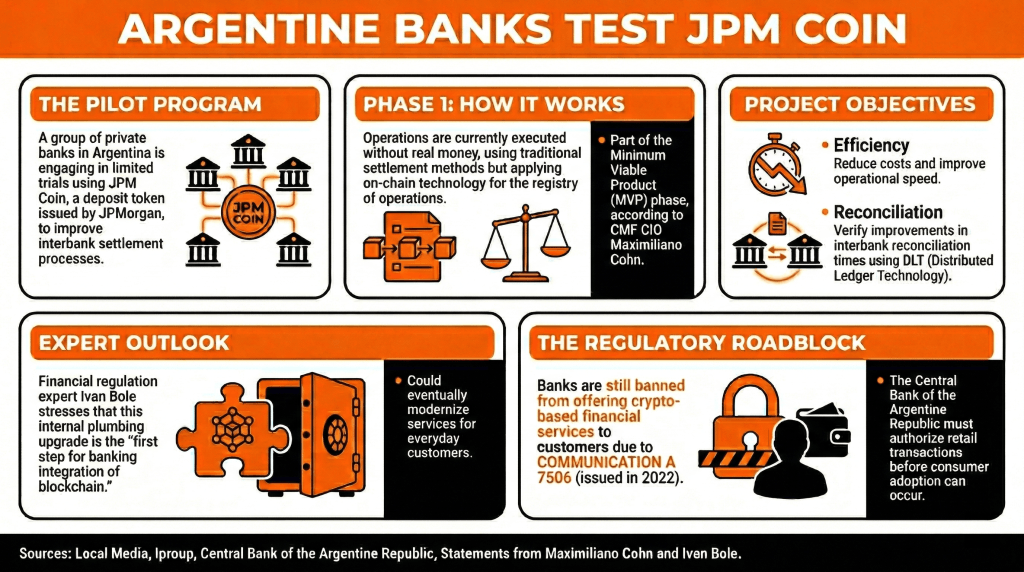
Maximiliano Cohn, CIO of CMF, one of the banks participating in these tests to be part of the minimum viable product (MVP) of JPM Coin in Argentina, told Iproup that these operations are being executed without money and using traditional settlement methods first, but applying on-chain technology for their registry.
Cohn also explained that during the first phase of this pilot, banks are working to integrate available services to “verify improvements in the settlement and interbank reconciliation times of the integrated banks.”
“While the concept is currently in the design phase, the objective is to implement DLT (Distributed Ledger Technology) to reduce costs and improve speed and operational efficiency,” he stressed.
Even when this move focuses on improving the internal plumbing of banking institutions, analysts believe it could be a starting point for modernizing these services to better serve customers. Ivan Bole, an expert in financial regulation, stressed that this was the first step for banking integration of blockchain.
Nonetheless, banks are still unable to offer crypto-based financial services to their customers, as Communication A 7506, issued in 2022, establishes that “financial entities may neither execute nor facilitate for their clients the execution of transactions involving digital assets—including crypto-assets and those whose returns are determined based on the fluctuations recorded by such assets—that have not been authorized by a competent national regulatory authority or by the Central Bank of the Argentine Republic.”
Related Articles

TitanRWA Taps GoldFinger to Broaden Gold-Driven RWA Tokenization
TitanRWA, a blockchain-based RWA tokenization platform, has partnered with GoldFinger, a blockchain entity for gold’s tokenization into digital assets. The partnership aims to connect...

DEXE dumps 15% as seller dominance surges – Warning sign?
$DEXE fell sharply even as the broader crypto market rebounded on easing global tensions and ceasefire talks. The altcoin dropped from $9.2 to $7.3...

KOFIA Chairman Demands South Korea Join Global Financial Trend
In a significant development for Asian financial markets, Korea Financial Investment Association (KOFIA) Chairman Hwang Seong-hyeop has publicly called for South Korea to introduce...
Bitcoin (BTC) trades flat as index declines
CoinDesk Indices presents its daily market update, highlighting the performance of leaders and laggards in the CoinDesk 20 Index. The CoinDesk 20 is currently...