
Crypto Capital Shifts to Stablecoins as Risk Appetite Falls, Market Cap Tops $320B

The crypto market remains under pressure as economic uncertainty and global tensions make investors less willing to take risks.
Bitcoin remains significantly below its previous peak, trading at approximately 41% under its all-time high. Altcoins have experienced even deeper losses, with more than $900 billion wiped from the broader segment’s total market value.
Despite this widespread decline in asset prices, the market has not seen a proportional exit of capital from the crypto ecosystem. Instead, on-chain data provides further insight into how this capital is being deployed.
Stablecoins Keep Growing
CryptoQuant analyst Darkfost noted that liquidity patterns suggest a redistribution of funds, with investors repositioning into more stable digital assets.
This shift is visible in stablecoins, which have been resilient throughout the downturn. The sector’s total market capitalization has far exceeded $260 billion and now stands at over $320 billion, despite the market contraction.
This trend suggests that capital is not abandoning the space but is instead being temporarily parked in dollar-pegged assets. Rather than converting holdings back to fiat and exiting the ecosystem, many investors are choosing to remain in crypto while reducing exposure to volatility.
Rising Inflows to Nexo Highlight Growing Role of Yield Platforms
Going further, Darkfost shows that stablecoin inflows into Nexo have increased consistently since February, indicating a sustained shift in investor behavior.
Weekly inflows, which previously averaged around $8 million, have climbed to approximately $15 million, with occasional peaks exceeding $20 million during periods of heightened market weakness.
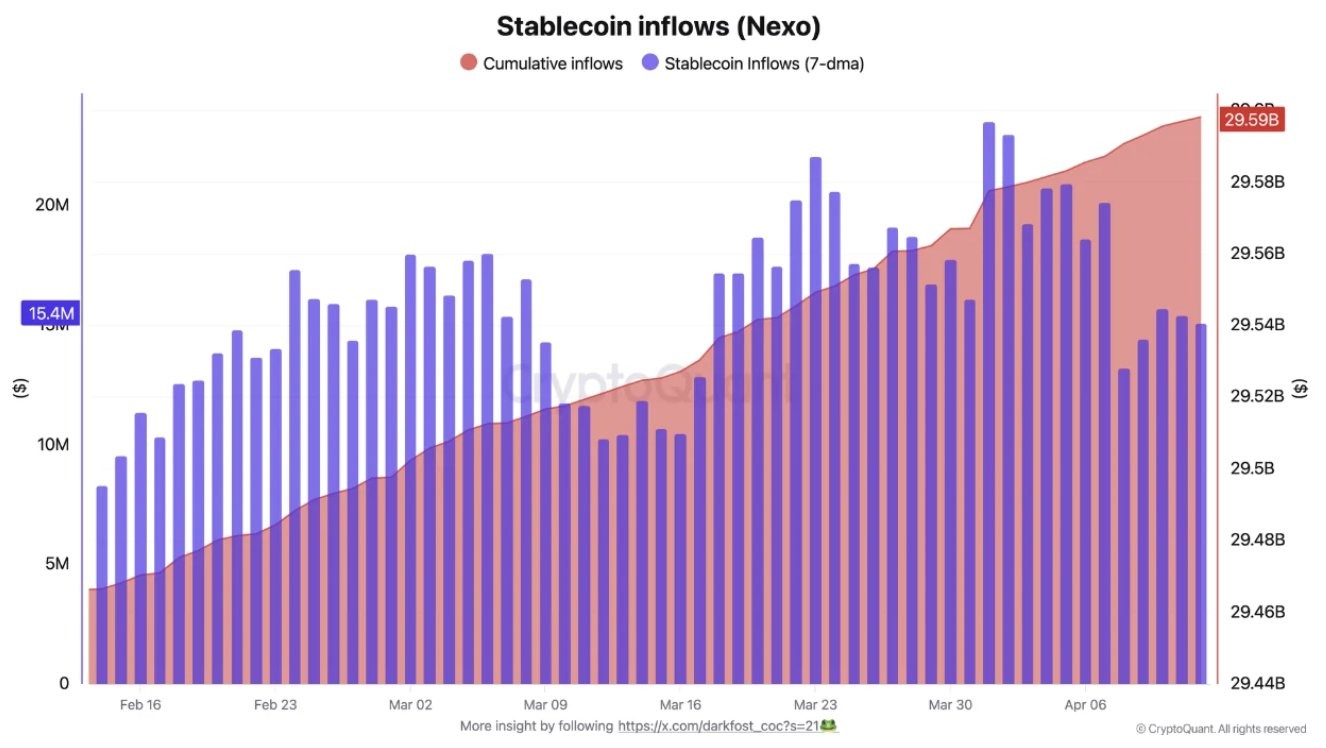
Over time, cumulative inflows have reached an estimated $30 billion, reflecting the growing scale of participation in yield-generating platforms.
This trend points to a change in investor behavior. Rather than withdrawing funds, many market participants are reallocating capital into stablecoins and deploying them on platforms that offer yield.
Products tied to USD Coins, for example, can provide returns of up to 10% in some cases, allowing users to generate income while remaining liquid.
The rise of such strategies reflects the growing role of financial services built around stablecoins. These tools enable investors to manage risk without leaving the crypto market entirely. By holding stablecoins, users avoid price volatility while maintaining the ability to re-enter positions quickly.
Related: South Korea to Legalize RWAs and Stablecoins Under Existing Laws
Related Articles

Your Crypto White Paper Can’t Just Be a Gitbook or PDF
When most people hear crypto white paper, they think of Satoshi Nakamoto’s nine-page document, or an ICO-era pitch deck dressed up in technical language....

DOJ, FinCEN face questions over Binance monitorships and Iran activity
The Justice Department and Treasury’s Financial Crimes Enforcement Network are being pressed by lawmakers over their supervision of Binance amid allegations that it helped...

Strategy’s returns to profit on bitcoin holdings after $76,000 surge
Bitcoin has decisively broken above $76,300 for the first time since its sharp selloff on Feb. 5, when it dropped to a low near...

Neo co-founder proposes $461M treasury overhaul to end ‘trust me’ governance
Neo co-founder Da Hongfei has proposed a sweeping overhaul of the Neo Foundation after years of deadlock with co-founder Erik Zhang left one of...